
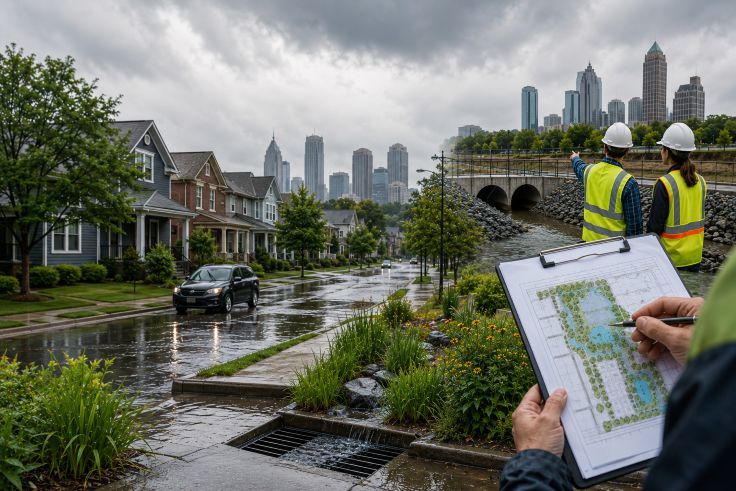
Urban flooding has become more frequent in many cities as heavier rainfall, expanding development, and aging infrastructure place greater pressure on drainage systems. Research from the Intergovernmental Panel on Climate Change (IPCC) shows that extreme precipitation events are increasing in many regions, while the U.S. Environmental Protection Agency (EPA) notes that paved surfaces reduce the ground’s ability to absorb rainwater, increasing runoff and flood risk.
Many discussions about water damage Atlanta GA focus on what homeowners can do to reduce risks around their own properties. Yet local flooding rarely results from a single cause. Heavy rainfall, neighborhood development, stormwater infrastructure, zoning decisions, and emergency planning all influence whether homes remain protected or experience costly water intrusion.
The Case for Personal Responsibility
Many property experts argue that homeowners should take primary responsibility for reducing flood risks on their own land. Regular maintenance often prevents avoidable problems before storms arrive. Clogged gutters, blocked downspouts, cracked foundations, poor grading, and neglected drainage channels can all increase the likelihood of water entering a building.
Guidance from the Federal Emergency Management Agency (FEMA) encourages homeowners to inspect drainage systems regularly, direct runoff away from foundations, and prepare emergency plans before severe weather occurs. These practical steps may reduce damage even when heavy rainfall overwhelms surrounding areas.
Supporters of this viewpoint also argue that property owners understand their homes better than anyone else. They can recognize recurring drainage issues, maintain retaining walls, install sump pumps where appropriate, and improve landscaping to slow runoff. Small improvements completed over time often cost significantly less than major structural repairs after flooding.
This perspective promotes accountability and preparedness. Waiting for government agencies to solve every drainage problem may leave homes unnecessarily vulnerable during increasingly unpredictable weather.
The Public Responsibility for Urban Flooding
The opposing argument recognizes that individual maintenance has limits. Even the most carefully maintained property can flood when surrounding infrastructure cannot manage intense rainfall.
Reports from the American Society of Civil Engineers (ASCE) consistently highlight the importance of investing in stormwater systems, aging drainage networks, roads, bridges, and other public infrastructure. Deferred maintenance increases vulnerability as communities grow and weather patterns change.
Zoning policies also influence flood exposure. Local governments decide where housing developments, commercial districts, parking areas, and transportation corridors are built. Every additional paved surface reduces natural infiltration unless balanced with effective stormwater management.
The U.S. Geological Survey (USGS) explains that urbanization increases surface runoff because rainfall reaches streams and drainage systems more quickly than it would in natural landscapes. As cities become denser, runoff volumes often rise unless planners include detention ponds, green infrastructure, permeable surfaces, and updated drainage designs.
Emergency planning is another public responsibility. Local governments coordinate evacuation routes, public alerts, road closures, disaster response, and recovery programs. Strong emergency management can reduce injuries, speed recovery, and improve community resilience after severe storms.
Where Atlanta Provides a Useful Example
Atlanta illustrates how multiple factors combine to influence flooding risks. The metropolitan area experiences frequent periods of heavy rainfall throughout the year. At the same time, decades of urban expansion have added roads, commercial developments, and residential neighborhoods across the region.
Studies published by the National Oceanic and Atmospheric Administration (NOAA) show that short-duration, high-intensity rainfall events can produce large amounts of runoff in urban environments. Older drainage infrastructure may struggle to accommodate rainfall that exceeds the conditions originally considered during construction.
Atlanta has also invested in infrastructure improvements over many years, including stormwater upgrades and watershed management initiatives. Even so, experts recognize that infrastructure projects require significant funding, careful planning, and ongoing maintenance to remain effective as cities continue to grow.
This creates an important balance. Residents can maintain their own properties responsibly, while public agencies continue improving systems that protect entire neighborhoods.
Finding Common Ground
The debate between private responsibility and public investment often presents a false choice. Property resilience depends on cooperation rather than assigning blame to one side.
Homeowners benefit from maintaining roofs, gutters, landscaping, drainage paths, and foundation protection. Local governments contribute by maintaining storm drains, updating flood maps, enforcing building standards, investing in resilient infrastructure, and preparing communities for emergencies.
The National Institute of Building Sciences (NIBS) has reported that investments in hazard mitigation often generate multiple dollars in future savings by reducing disaster losses. Those benefits apply across public infrastructure projects as well as private mitigation measures.
Climate adaptation planning further strengthens this partnership. Communities increasingly incorporate green infrastructure such as rain gardens, bioswales, permeable pavements, and expanded tree canopies. Research from the EPA indicates these approaches can reduce runoff while improving water quality and supporting healthier urban environments. Many of the same principles also apply to maintaining commercial buildings for long-term resilience, where proactive inspections, drainage management, and preventive maintenance can reduce the impact of severe weather while supporting safer, more durable properties.
Building More Resilient Communities
Property resilience is shaped by decisions made long before a storm arrives. Maintenance habits, zoning policies, infrastructure investment, environmental planning, and emergency preparedness all contribute to how communities respond when heavy rain falls.
Residents cannot replace regional stormwater systems, just as governments cannot inspect every private drainage pipe or clean every home’s gutters. Each plays a different role in reducing risk.
As weather patterns continue evolving, successful flood management will depend on cooperation between homeowners, engineers, planners, emergency managers, and elected officials. Balanced policies that encourage responsible property maintenance while supporting modern infrastructure investments offer one of the strongest paths toward reducing future flood losses. Rather than viewing flooding as solely a private or public problem, communities benefit most when both responsibilities work together to strengthen resilience for everyone.